
Three good years, then one bad quarter
Radcom sells software that watches telecom networks. Revenue went from $51.6 million in 2023 to $61.0 million in 2024 and $71.5 million in 2025, up 18.2% and then 17.2%, and operating profit went from a $0.7 million loss to $3.1 million and then $8.3 million: a margin of minus 1.3% to 11.6% in two years. The only acquisition in the period was Continual, bought for $2.5 million in April 2023. The filing gives no separate revenue figure for it, so the growth was mostly, though not provably entirely, organic.
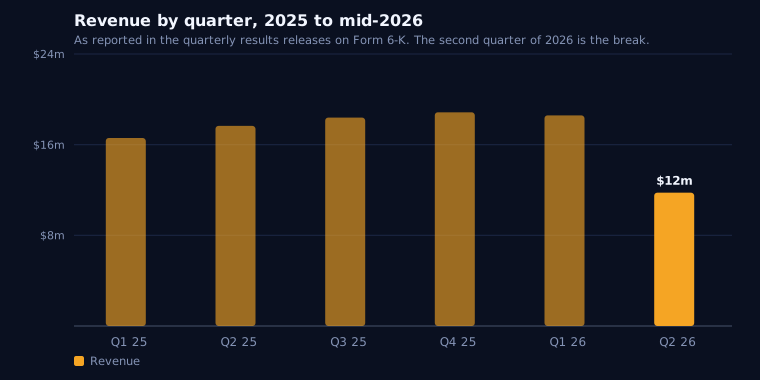
Then, on July 30, 2026, the company said second-quarter revenue would be about $12 million, against $17.7 million a year earlier, and cut its 2026 outlook from 8% to 12% growth to a range of $57 to $63 million. At the midpoint that is 16.1% below 2025. The shares closed at $12.72 on July 29 and $10.03 on July 30, down 21.1% in a day, and at $10.37 on September 18, 2026, the price every figure below uses. The highest close in the preceding twelve months was $16.14, on May 8 and May 11, 2026. All prices are Nasdaq daily closes as held in our own store.
Between February and September, shareholders holding about 19% requisitioned a meeting to remove five directors, all five resigned before the vote, the largest holder asked for a review of strategic alternatives, and the board authorised a buyback of up to $20 million.
The question this piece tests is whether 2026 is a pause or a new level.
The machine
In the company's words, Radcom is "a leader in automated assurance and intelligent analytics for telecom operators." In plain terms: its software captures and analyses the traffic crossing a mobile network, from the radio network to the core, so that an operator can see when service degrades, for which subscribers, and why. The flagship is RADCOM ACE, which the 20-F describes as cloud-native: containerised software that runs on public clouds (AWS, Google Cloud and Azure are named) or on an operator's own hardware. Newer products sit on top of it, including a generative AI assistant launched in 2024 and an "AI agent suite" called RADCOM Neura, launched in February 2026. A launch is not adoption, and the filing gives no revenue for either.
The 20-F says its solutions have been "Chosen by AT&T, DISH Purchasing Corporation, or Dish, Rakuten Mobile, Rakuten Symphony Singapore Pte. Ltd., Telia Mobil Danmark A/S, or Telia Denmark, and others," and names Telefonica, Norlys and WINDTRE elsewhere. The AT&T and Rakuten agreements are filed as material contracts.
Revenue comes in two halves, and they behaved differently.
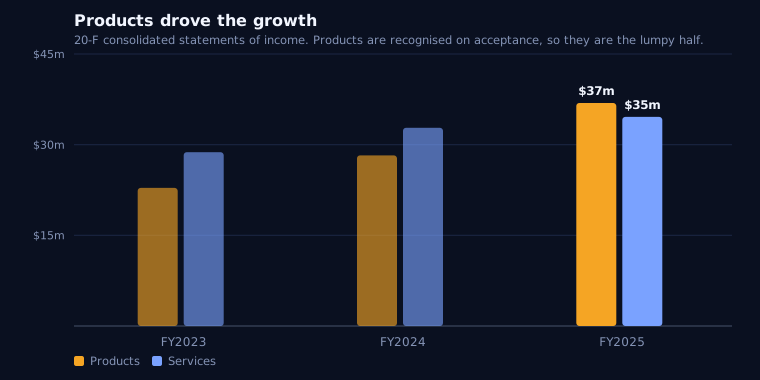
| Revenue by type | 2023 | 2024 | 2025 |
|---|---|---|---|
| Products | $22.8m | $28.2m | $36.9m |
| Services | $28.8m | $32.8m | $34.6m |
Products grew 30.8% in 2025, services 5.5%. Products are recognised "at a point in time," on acceptance or licence delivery, so they are the half that arrives in lumps and the half that can disappear from a quarter. Services, recognised over time, are the steadier base. Radcom says it is "shifting to multi-year recurring revenue contracts," and at December 31, 2025 it reported $65.5 million of remaining performance obligations, about 67% of which it then expected to recognise within twelve months. That expectation is from before the delays.
Gross margin was 76.0% in 2025. Below it, research and development, sales and marketing, and administration cost $46.0 million. The company had 325 staff and contractors at year end, 152 of them in research and development, with 143 in Israel and 67 in India.
Why it is down
The company's explanation, in its second-quarter results of August 12: revenue "was affected by deployment delays at some customers, as higher component costs and supply constraints slowed the buildout of the infrastructure required to deploy RADCOM's solution and delayed customer purchasing decisions." The July 30 release says "The Company did not experience cancellations or competitive losses" and calls the delays "timing considerations rather than changes in demand." The chief executive, Benny Eppstein, is quoted there: "We expect to return to double-digit growth in 2027." These are the company's account and its expectation. Nothing in the filings lets a reader test either.
The half year, from the unaudited statements:
| H1 2025 | H1 2026 | |
|---|---|---|
| Revenue | $34.2m | $30.3m |
| Gross margin | 75.3% | 75.5% |
| Operating expenses | $22.6m | $24.5m |
| Operating profit (loss) | $3.2m | ($1.6m) |
| Net income (loss) | $4.9m | ($0.04m) |
Gross margin held. That is consistent with the company's account of a delay rather than lost pricing, though it does not prove it. Operating expenses rose 8.4% while revenue fell, with gross research and development up 17.4%: management has not cut spending.
The first quarter of 2026 was still a growth quarter: $18.6 million, up 12.0%, with operating profit of $2.2 million. The second was the break. The full-year range implies second-half revenue of $26.7 to $32.7 million, against $37.2 million a year earlier.
Since the quarter closed, the company has announced three contracts: CETIN Networks in Slovakia, a new customer replacing a legacy vendor; VNPT in Vietnam, won in a tender that displaced the incumbent and which the company itself calls "modest in size"; and a renewal with an existing European customer. None has a disclosed value.