A school group that grew, and a second half that slowed
Legacy Education runs four career colleges in California that train nurses, sonographers, surgical technologists, medical assistants and veterinary technicians. It went public in September 2024, selling 2,500,000 shares at $4.00 in an offering that closed on September 27, 2024. In its year to June 30, 2026 it reported revenue of $80.1 million, up 24.8%, operating income of $11.8 million and net income of $9.1 million, up 21.3%. At June 30 it held $22.7 million of cash against $0.13 million of borrowings and a $0.15 million finance lease.
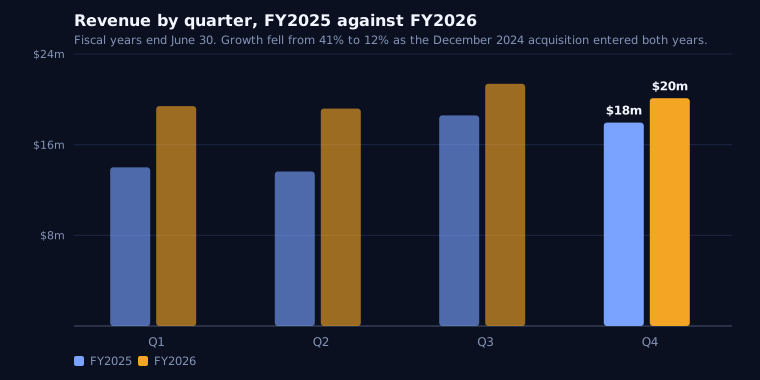
Part of that growth is an acquisition. Contra Costa Medical Career College joined on December 18, 2024, so it counts for a little over six months of the prior year and all of this one. The company's own unaudited pro forma revenue for FY2025, as if it had owned the college throughout, is $68.2 million. Against that, FY2026 revenue grew 17.4%. That is growth against a pro forma base, not a measure of organic growth: it does not separate price, program mix or new programs.
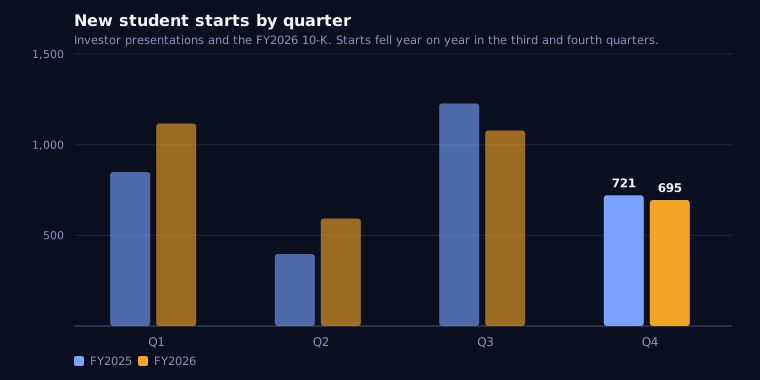
Quarter by quarter, reported growth fell from 38.5% and 40.7% in the first two quarters to 15.0% and 12.0% in the last two, the quarters in which the acquisition was in both years. The filings do not break the slowdown down further. New student starts, the number of students beginning a program, fell year on year in both of the last two quarters: 1,078 against 1,227 in the third, and 695 against 721 in the fourth.
The results were released after the market closed on September 24, 2026, the day the annual report was filed. The shares closed at $10.64 that day and at $9.31 on September 25, the first session after, down 12.5%. $9.31 is the price every figure below uses. The highest close in our price record, which begins on September 26, 2024, was $14.33, on March 4, 2026. Prices are Nasdaq daily closes as held in our own store.
The question this piece tests is whether the growth is turning into cash, and what the filings say about the regulation it depends on.
The machine
In the 10-K's words, the company provides "career-focused, post-secondary education services to students at all stages of adult life." The four institutions, with students enrolled at June 30, 2026:
| Institution | Where | Students | Joined the group |
|---|---|---|---|
| High Desert Medical College | Lancaster, Bakersfield, Temecula | 2,097 | July 2010 |
| Central Coast College | Salinas | 576 | January 2019 |
| Contra Costa Medical Career College | Antioch | 508 | December 2024 |
| Integrity College of Health | Pasadena | 196 | 24.5% in December 2019, the rest in September 2020 |
The programs run from short certificates to associate degrees, mostly in healthcare. The filing's own examples of estimated total fees, charges and expenses: $92,235 for the Associate Degree in Nursing at High Desert, $60,894 for the ultrasound associate degree, $36,370 for the vocational nursing diploma. These are list estimates, not revenue per student. Teaching is mainly on campus, with hybrid approval for all programs. The students, per the filing: 60% Hispanic, 86% women, 52% aged 24 or younger.
The company reports an average placement rate of 72.7% and an 82.4% pass rate on the national nursing licence exam, both as of June 30, 2026. These are company-reported figures; the filing does not give the cohorts or denominators behind them, and it does not disclose completion or graduation rates. It names its competitors as "San Joaquin Valley College, Career Care Institute, UEI College, Bakersfield College, American Career College, and the Pima Medical Institute."
LeeAnn Rohmann founded the company in October 2009, has chaired it since then and has been chief executive since July 2010. Growth plans in the filing: registered nursing programs in Bakersfield and Salinas, a first campus outside California in Houston (lease signed September 14, 2026, opening projected for November 2026, with some Texas approvals not yet applied for), and acquisitions in "Texas, Nevada, Colorado and New Mexico and programs in trades."
Where the cash went
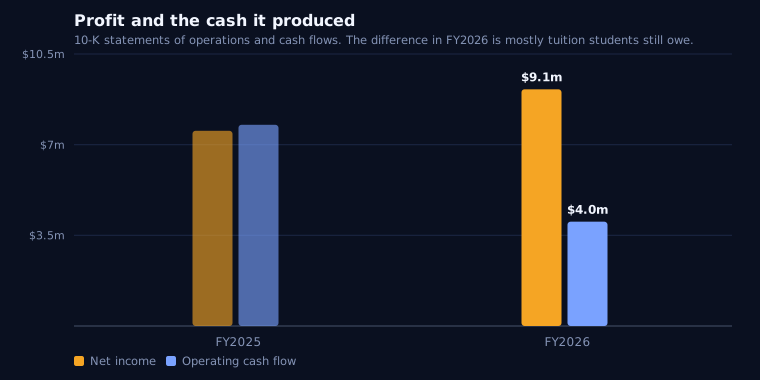
The 10-K explains the gap itself: "Net cash provided by operating activities was approximately $4.0 million in fiscal year 2026, compared to approximately $7.8 million in fiscal 2025, a decrease of approximately $3.7 million. The decrease was primarily attributable to the $9.0 million increase in accounts receivable in fiscal 2026, compared to a $3.9 million increase in fiscal 2025."
The $9.0 million is the line in the cash flow statement, before the provision for credit losses is added back separately. On the balance sheet, net receivables rose by $5.0 million, after $4.0 million of provision.
| FY2025 | FY2026 | |
|---|---|---|
| Net income | $7.5m | $9.1m |
| Operating cash flow | $7.8m | $4.0m |
| Capital expenditure | $0.8m | $1.3m |
| Accounts receivable, net, June 30 | $17.0m | $22.0m |
| Provision for credit losses | $3.4m | $4.0m |
| Balances written off | $2.5m | $3.7m |
The receivable is owed by individual students, not by the government. The company extends credit itself: "we offer payment plans to all students, regardless of financial need, for up to 6 years." At June 30, 2026, $2.2 million of the receivable was not due within a year; the filing does not say how much of the $22.0 million is on payment plans. Net receivables rose 29.4% in a year in which revenue rose 24.8%. Write-offs rose 48.7%, to $3.7 million, faster than either. The provision was 5.0% of revenue, against 5.3% the year before; it is an accounting estimate, not a measured loss rate. Deferred, unearned tuition fell from $5.0 million to $4.8 million.
Operating cash flow was $4.0 million against net income of $9.1 million: 44% of profit, against 103% in FY2025. Free cash flow, operating cash flow less capital expenditure, was $2.7 million, 29% of profit. Quarter by quarter, operating cash flow was $1.06 million, $1.06 million, $0.76 million and $1.15 million, derived from the year-to-date figures. Two of the company's investor presentations labelled a cumulative figure as a quarter's: slide 26 of the August 2026 deck says "During Q3 2026, Legacy generated $2.9M in net cash from operating activities," which is the nine-month total, and slide 26 of the March 2026 deck labels the six-month $2.1 million as the second quarter's.
The 10-K gives no ageing of the receivable, no separate balance or terms for the payment plans, and no collections by year of origin. Total gross receivables can be derived: $24.0 million before the $2.0 million allowance. The missing detail, with collections after the balance sheet date, is what would let a reader judge how much of the $22.0 million is likely to be collected.