
The story that stopped working
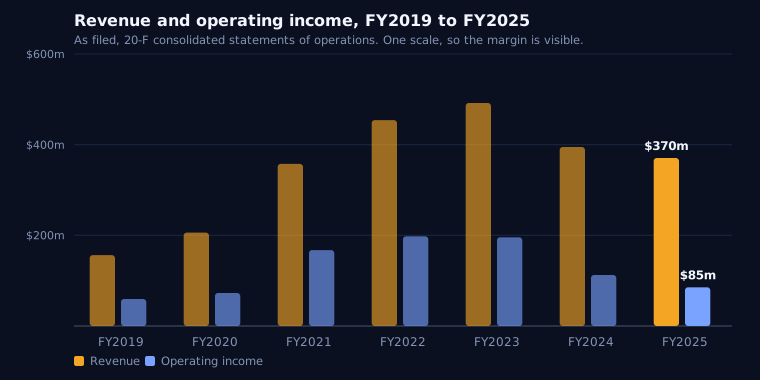
For three years InMode was the most profitable company nobody believed. An Israeli maker of radiofrequency aesthetic devices, listed on Nasdaq in 2019, compounding revenue near 40% a year at a 40% operating margin. In 2023 it earned $196 million of operating profit on $492 million of revenue. Software companies do not reliably earn 40% operating margins. This one did it selling hardware to dermatologists.
On a split-adjusted basis the shares closed at $97.86 on November 2, 2021, the highest close in our price history, which begins in January 2021. They closed at $14.89 on September 14, 2026. Every price figure here uses that close, from our own daily bars. The 2019 listing price of $14 is $7 on the same basis, after the two-for-one split in 2021, and we hold no prices from that year.
Revenue has fallen from $492 million to $370 million in two years. Operating margin has gone from 40% to 23%. The company that could not stop growing has now shrunk twice in a row.
The question is whether a business is breaking or a market is turning. The price has already answered with total confidence, and that answer is what we are testing.
The machine
InMode sells capital equipment to aesthetic practices. A physician buys a platform, uses it for minimally invasive procedures using radiofrequency energy, and charges patients who pay cash. No insurer reimburses any of it. Every dollar of end demand is discretionary consumer spending, reached through a small business that usually finances the machine.
Sixteen platforms since 2010, including BodyTite, Morpheus8, EvolveX and, in 2025, ApexRF and Solaria. That count is the filing's own, in Item 4B. Its risk factors give the same total a different way, fourteen platforms plus two introduced in 2025, and name Luxora and ApexRF rather than Solaria. The totals agree; the names and the grouping do not, and Item 4B's prose enumerates seventeen names against a product table that groups two of them.
The economics split in two, and the two halves are behaving very differently.
| Revenue by type | 2023 | 2024 | 2025 |
|---|---|---|---|
| Capital equipment | $412.1m | $315.5m | $289.1m |
| Consumables and service | $80.0m | $79.3m | $81.4m |
Capital equipment is down 30% from FY2023 to FY2025. Consumables and service, the revenue from machines already installed in clinics, is flat and slightly up. The recurring half has not deteriorated at all. The half that requires a physician to sign a new equipment lease has collapsed.
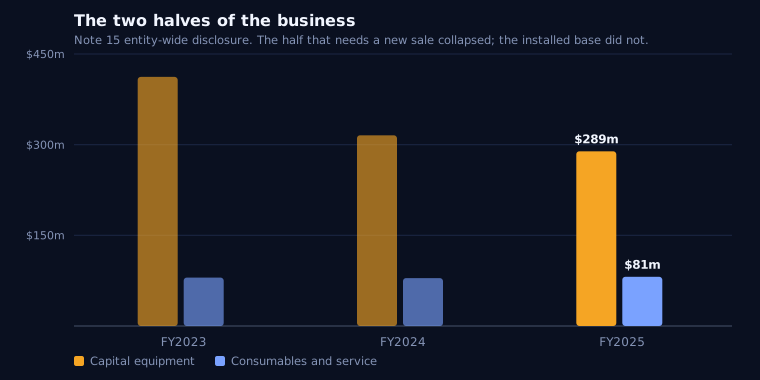
That table is the investment case, in both directions.
Why it is down
InMode's own explanation, in the FY2025 annual report: revenue fell because of "the overall slowdown in the demand for aesthetic procedures, in addition to challenging financing market in the United States."
The geography supports it.
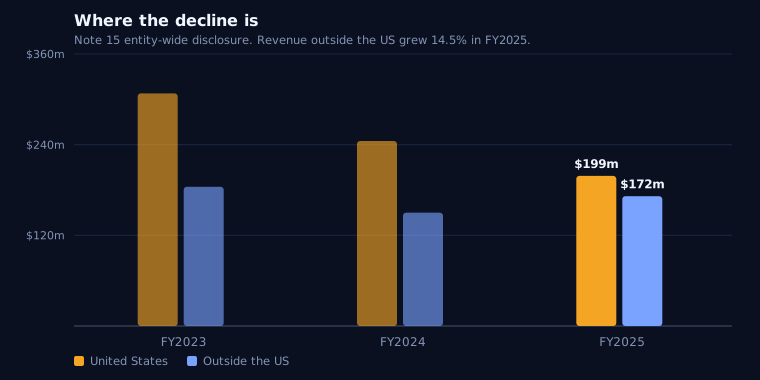
| Revenue by region | 2023 | 2024 | 2025 |
|---|---|---|---|
| United States | $307.8m | $244.8m | $198.7m |
| Outside the United States | $184.2m | $150.0m | $171.8m |
US revenue is down 35% from FY2023 to FY2025, and down 18.8% in FY2025 alone. Revenue outside the US grew 14.5% in FY2025 against FY2024. This is not a product being rejected worldwide. It reads as a US capital equipment cycle with a mechanical cause. To put numbers on the mechanism, ours and not the filing's: a dermatologist financing a $100,000 platform over five years pays roughly $2,076 a month at 9% against $1,842 at 4%, so about $2,810 a year more leaves the practice in debt service before anything reaches it. In a soft aesthetics market that extra throughput is exactly what is uncertain. The platform price and the rates are illustrative; the filing gives neither.
Inside the decline, the mix moved. In FY2025 minimally invasive platform sales fell $55.0 million and hands-free platforms fell $12.7 million, while non-invasive grew $43.4 million on ApexRF and Solaria. The new products sell. They do not yet offset the decline in the flagship category.